

Vineyard Update
Despite receiving decent rainfall during the winter, this year’s notably dry conditions during January and February have left our vineyard soils with less moisture than we would typically like to see heading into the growing season. As a result, we began irrigating about a month earlier than normal to help maintain vine balance and support healthy canopy growth as the season progresses. Even with the dry start, the vines are looking healthy, focused, and full of energy as they continue the journey toward harvest.
In terms of timing, the season is currently tracking about two weeks ahead of last year. The dry conditions and warm stretches throughout spring have accelerated vine development, pushing the vineyard forward earlier side of average for the Russian River Valley. If weather patterns remain steady through the summer months, we anticipate harvest beginning in early September. While there is still a long way to go, the vineyard has responded well so far, and we remain optimistic about the quality and balance of the vintage ahead.
 A Pinot Noir cluster mid-bloom in the Estate Vineyard. This short but critical stage helps determine the size and uniformity of the upcoming vintage.
The vineyard has recently moved through one of the most critical periods of the growing season: bloom. This is the stage when pollination and fertilization occur, eventually forming the grape clusters that will be harvested later this season. Unlike many other agricultural crops, grapevines are self-pollinating, meaning each tiny flower contains both male and female parts and does not rely on bees or outside pollinators. Instead, successful pollination depends heavily on stable weather conditions during bloom.
This year, weather during bloom was somewhat inconsistent, with periods of wind and fluctuating temperatures moving through Sonoma County during this critical window. Despite those conditions, our vineyard experienced a strong fruit set overall, and the vines continue to look healthy and balanced heading into summer. Some areas throughout Sonoma County did experience varying levels of shatter, where flowers fail to fully develop into berries, which will likely reduce yields in certain vineyards this season. Fortunately, our sites appear to have come through bloom in very good shape, and we remain optimistic about the quality of the vintage ahead.
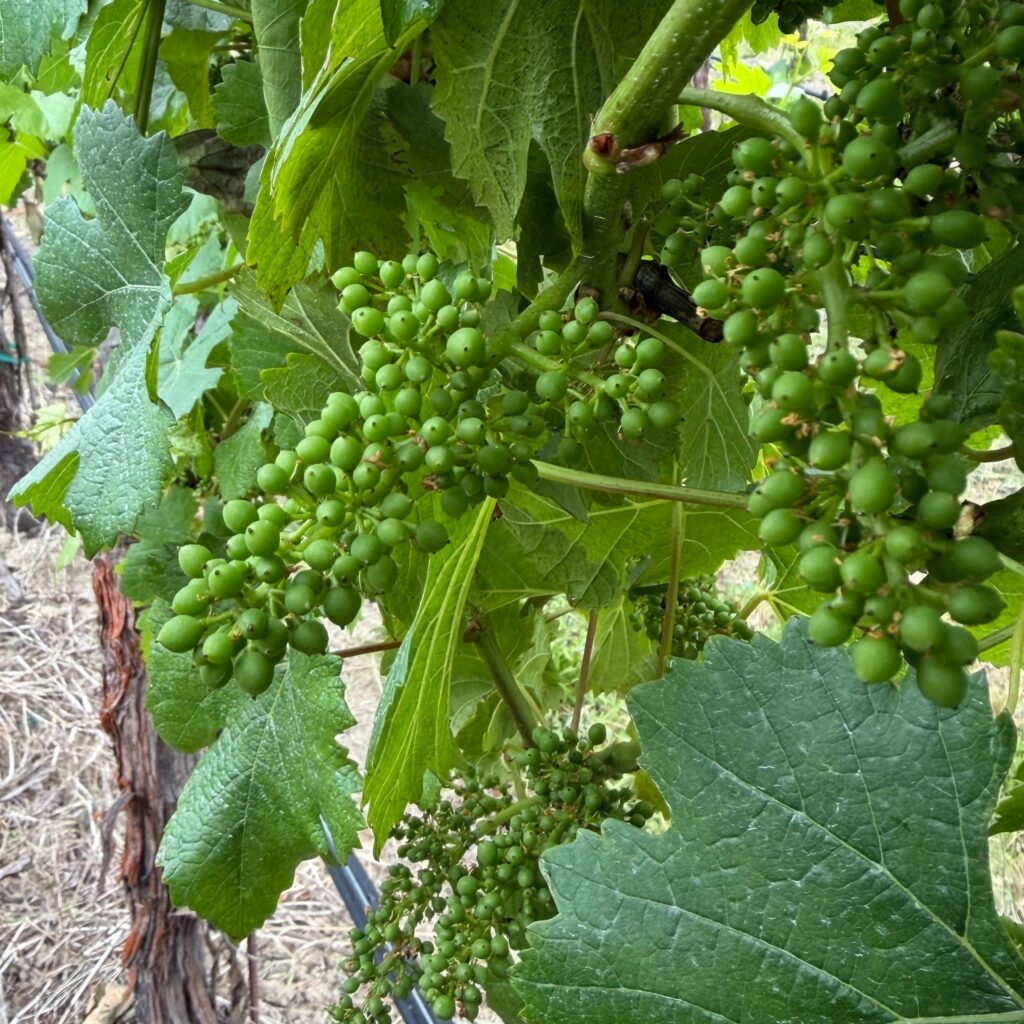 Following bloom, Pinot Noir clusters are now entering fruit set with berries beginning to size evenly throughout the vineyard.
Meanwhile, vineyard crews have been busy managing the rapidly growing canopy as the vines continue pushing strong early-season growth. One of the key tasks recently completed was shoot thinning, an important step where weaker or poorly positioned shoots are removed to help direct the vine’s energy toward the healthiest and most balanced growth. This process helps regulate crop load, improves uniformity throughout the canopy, and prevents excessive congestion around the fruiting zone.
Following shoot thinning, we began moving catch wires upward through the trellis system to guide the remaining shoots into a more vertical growth pattern. Keeping the canopy organized is essential this time of year, allowing for better airflow, improved sunlight penetration, and more effective disease prevention—particularly against mildew pressure as temperatures begin to warm heading into summer.
 Daily marine fog rolls through the Estate Vineyard in the early morning hours. Just fourteen miles from the Pacific Ocean!
The fog in the Russian River Valley AVA of Sonoma County plays a vital role in shaping its renowned winegrowing conditions. Each day, cool coastal fog flows inland over the low-lying coastal hills and along the Russian River, blanketing vineyards and dramatically moderating temperatures. This cooling influence slows grape ripening, preserving acidity and enhancing flavor complexity—ideal for varietals like Pinot Noir and Chardonnay. The daily fog cycle creates a distinct diurnal temperature swing, protecting grapes from heat stress while extending hang time. This unique microclimate fosters elegant, balanced wines, making fog the defining natural element of the region’s viticultural identity!
On behalf of the entire team here at River Road Family Vineyards and Winery, we wish you all continued good health!
