

Awaiting Bud Break and Frost Season
At River Road Family Vineyards and Winery in the heart of the Russian River Valley, the transition from winter to spring marks one of the most important times of the year. As temperatures gradually warm, the vines come out of dormancy with a process called “bud break”. The first few weeks of this month the dormant buds will begin to swell, shifting from tight, compact nodes to a soft, popcorn-like stage before the first tender green leaves emerge. The leaves emerging is “Bud Break”! The last two years we’ve witnessed it happen right around the 27th of this month. The appearance of young leaves signals the start of “frost season,” when vines are especially vulnerable to freezing temperatures.
 A cold frosty morning at Stephanie’s Pinot Noir Vineyard. Both the winemaking team and the vines eagerly await the sun rise!
Even a brief frost event can significantly impact crop size and fruit quality, making vigilance essential. To prepare, our vineyard team carefully inspects and maintains overhead frost-protection sprinklers and water lines to ensure they are fully operational. Frost season typically extends from bud break through April and sometimes into May, requiring constant monitoring of weather forecasts and temperature alerts. When temperatures approach 36 degrees fahrenheit, our alert system prompts immediate action, often sending team members into the vineyard overnight to activate protection systems. After two mild frost seasons in a row, we remain hopeful for similarly favorable conditions this spring!
Pinot Noir
Pinot Noir is widely regarded as one of the most historically significant and viticulturally influential grape varieties in the world. It has been cultivated for centuries and remains foundational to the identity of some of the most prestigious wine regions, particularly here in the Russian River Valley. Modern DNA profiling confirm that Pinot Noir is among the oldest continuously cultivated grape varieties and a genetic parent of Chardonnay through a natural cross with Gouais Blanc. Historical records document its prominence in medieval Burgundy, and in 1395 Philip the Bold, Duke of Burgundy, issued an edict banning Gamay in favor of Pinot Noir, solidifying its association with quality wine production. The name “Pinot” derives from the French word pin, meaning pinecone, a reference to its small, tightly clustered, cone-shaped bunches. Because it is propagated by “cloning” or taking a cutting of a mother plant, Pinot Noir has maintained genetic continuity for over a millennium.
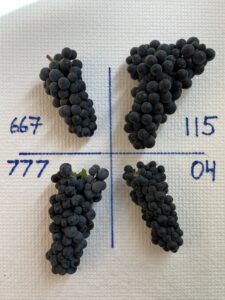 These are the four different Pinot Noir clones we grow in Stephanie’s Vineyard, 667, 115, 777, and 04. Each one brings its own flavor to the mix!
Pinot Noir is used almost exclusively for premium wine production rather than table grapes or raisins due to its small berries, thin skins, and moderate yields. It is best known for producing elegant still red wines that are lighter in color and tannin than varieties such as Cabernet Sauvignon or Syrah, yet highly prized for aromatic complexity and site expression. Typical sensory descriptors include red cherry, raspberry, rose petal, forest floor, and baking spice. Its thin skins result in lower anthocyanin and tannin levels, contributing to a softer structure and refined texture. Pinot Noir evolved under Burgundy’s continental climate, characterized by cold winters, moderate summers, and recurring spring frost, conditions that favor early ripening varieties capable of achieving balance in cooler growing seasons. Conditions very similar to the Russian River Valley, where maritime influence and fog moderate temperatures. Pinot Noirs unparalleled capacity to express terroir with precision and elegance has made it one of my favorite grape varieties to work with!
On behalf of the entire team here at River Road Family Vineyards and Winery, we wish you all continued good health!
Be Well,
